

There is a gap that exists in almost every organization, at every level of maturity, regardless of how talented the leadership team is. It is the gap between what a leader asks for and what actually happens at the point of execution. And it is one of the most consequential drags on organizational performance that almost nobody talks about directly.
It is not a communication problem in the traditional sense. The ask was made. People heard it but the team delivered a version of it — a smaller version, a safer version, the version that required the least amount of disruption to produce. The leaders used their latitude to translate the ask into the existing processes and delivered enough results to declare success. The senior leader, wanting to reinforce ownership and maintain a positive environment, recalibrates expectations.
This happens at every level of the hierarchy, and it compounds. A senior leader makes a request of a director. The director interprets it through the lens of what they believe is achievable without creating too much friction on their team. They pass a filtered version of the ask to their managers. The managers do the same. By the time the request reaches the people who are actually doing the work, it may look nothing like what the senior leader had in mind because each layer quietly adjusted the bar to something they felt confident they could clear.
This recalibration of expectations is what sets off the slow erosion of operating potential. The leader believes they are being responsive. The team learns what the real standard is. The gap widens without anyone deciding to widen it. Rather than recalibrating expectations I’ve always viewed this situation as an opportunity to drive improved performance. The challenge is doing it in a way that maintains a positive and motivating environment. For me this meant focusing on fully understanding the situational dynamics and coaching leaders how to make better informed decisions. It also meant providing them support to expand the scope of changes they can make and give them enough air cover to make and learn from mistakes.
Over time operational discussions evolved. As I would establish goals we would discuss the scope of change required to achieve the goal. And as we would implement the changes, we could make real time adjustments that would allow us to keep the original goal intact. Throughout the process my leadership team would gain confidence and feel more empowered. For true leaders there is no better environment.
The problem with calibrating on feel
But none of this works without an honest read of what is actually happening. When you are calibrating based on what people tell you, you are working with information that the organizational dynamics created – the same ones that created the gap in the first place. People are not being dishonest. They are telling you what they believe. And the friction they experienced, the constraints they bumped into, and the standard they have always been held to shaped what they believe
This is why objective data matters. Not to catch people — but to give you something to calibrate against that those dynamics didn’t shape. The data does not feel the friction. It does not know what people believe is possible. It just shows what is actually happening. And sometimes what it shows is that the gap between what was delivered and what was achievable is larger than anyone was willing to say out loud — or even recognized.
The investment needed for organizational discipline
Understanding why the gap exists is where the real leadership work happens. When the team does not deliver what you asked for, the most important question is not who failed to deliver. It is why. Because the answer is almost always a coaching opportunity — a perspective the person was missing, a constraint they did not surface, a capability gap that nobody had named yet. Closing that gap is more durable than repeating the ask. And it is the kind of investment that compounds — an organization that gets better at closing the gap between intent and execution gets better at everything else too.
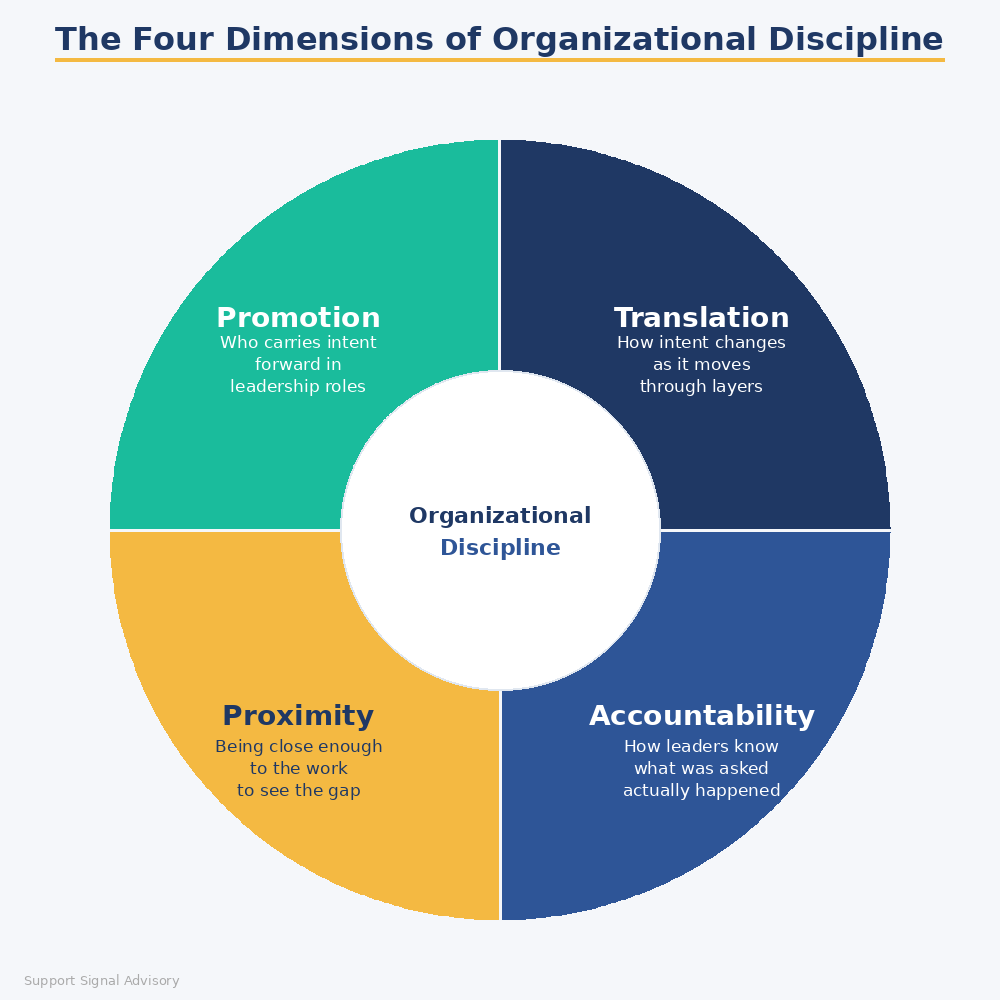
This is the foundation of what I think of as organizational discipline — the degree to which what a leader intends and what the organization actually does are the same thing. It has four dimensions worth examining separately: how intent translates through layers, how leaders know whether what they asked for actually happened, who gets promoted into leadership roles, and whether leaders are close enough to the work to see the gap before it becomes entrenched.
Each of these is a post in this series. Each one stands alone, but they are more powerful together — because organizational discipline is not one thing. It is the accumulation of decisions made across all four dimensions, every day, at every level of the organization. The payoff is an organization that builds genuine capability over time — one where the gap between what is asked and what is delivered gets smaller with each passing year rather than larger.
Where does your organization sit on that spectrum? The answer is usually visible in the gap — if you are willing to look for it.
This is the first post in a series on organizational discipline — the foundation that determines whether what a leader intends and what actually happens at the point of interaction are the same thing. Future posts will explore each of the four dimensions in depth.

Leave a Reply